
PixWire
Crisis Communications
The first hour of a brand crisis decides the next six months
Shubham Verma, Founder & Reputation Lead5 min read
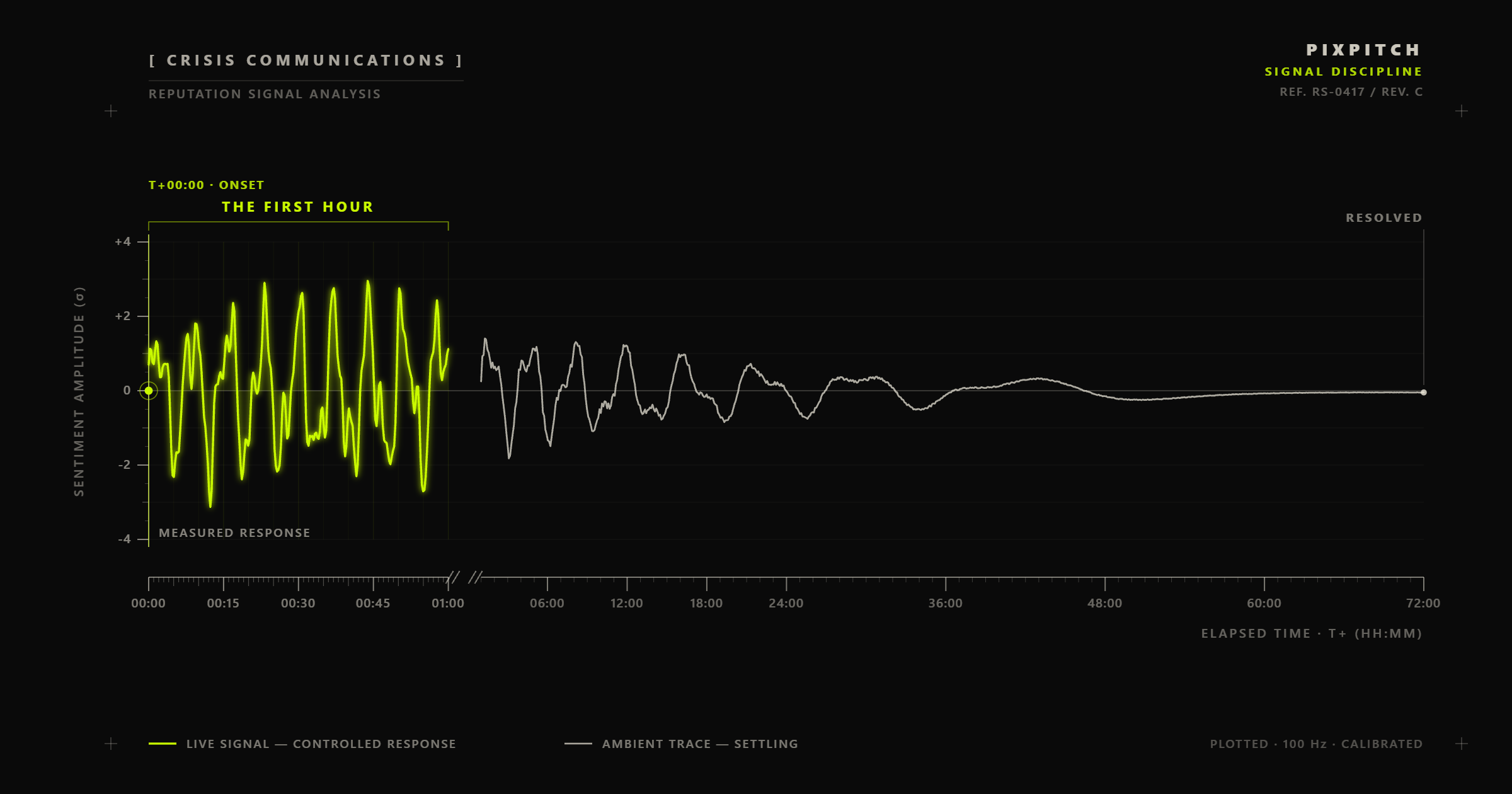
Most brands think a crisis is a writing problem. Something bad happens, and the room fills up with people arguing over the wording of a statement while the clock runs. By the time the perfectly balanced paragraph goes out, the damage is already set, because the thing that actually decided the outcome happened in the first hour, long before anyone hit publish.
The first hour is not about what you eventually say. It is about how fast, and how honestly, you move while you still do not have all the facts.
Here is what makes the first hour so strange to handle. It is exactly the moment you know the least and the moment people most want to hear from you. Your instinct, and every cautious voice in the room, will tell you to wait until you have the full picture. That instinct is aimed at the wrong risk. People rarely turn on a brand for saying "we are aware of this and we are looking into it, we will update you within the hour." They turn on a brand for silence, because silence in a vacuum gets filled with the worst possible version of the story, told by everyone except you.
The first move is almost never the full statement. It is a holding line, sent fast, that does three things: it shows you are aware, it shows you are taking it seriously, and it tells people exactly when they will hear more, a real time, not "soon." Then you actually come back at that time, even if all you have to say is that you are still working on it. A crisis is survivable. Being caught not caring, or hiding, is what people remember a year later.
In the noise of a crisis it is easy to start performing for the angriest people online, the ones already unpersuadable. They are not the audience. The audience is the much larger group watching quietly to decide whether this is a brand they can still trust. You are not writing to win the argument with the angriest person. You are writing so the quiet majority sees a company behaving like an adult.
This is the hardest part, and it is why crisis communication is a discipline and not a template. There is a real difference between "we do not have all the details yet, here is what we can confirm and here is when we will know more" and the corporate fog of "we are monitoring the situation." The first sounds like a person. The second sounds like a company hoping you will get bored and leave. The fog costs you more trust than the bad news ever would.
None of this is about spin. The brands that come out of a crisis stronger are almost never the ones with the cleverest statement. They are the ones who treated the people affected the way they would want their own family treated if the roles were reversed. Fast, honest, human. You cannot write your way out of a crisis in the first hour if you have not already decided how you will behave in it. Get the reflex right and the statement almost writes itself. Get it wrong and no amount of wordsmithing at hour six will save you.
New notes on reputation, PR and community, straight to your inbox. No spam, unsubscribe anytime.